Natural Rubber Weekly: Bull-Bear Battle Unchanged, Firm Range-Bound Pattern Continues
1. Rubber Spot Market Analysis
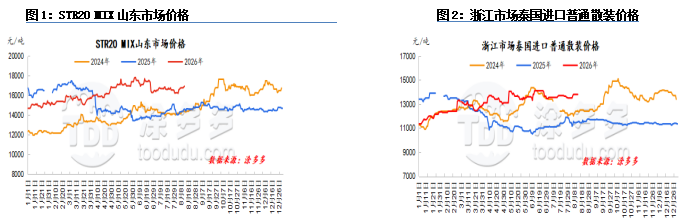
Natural rubber prices were steady first and then rose this week. At the start of the week, quotes continued from the end of last week and stayed broadly stable, but the stability lasted only briefly before prices began trending modestly higher. From a supply–demand perspective, rainy weather in production areas at home and abroad has disrupted tapping operations, new rubber output has fallen short of expectations, and cost-side support is evident from below. However, downstream product makers continue to buy mainly for rigid needs, and overall supply remains in a weak pattern, which to some extent weighs on the upward momentum of rubber prices. With bullish and bearish factors intertwined in the near term, rubber prices have entered a stalemate.
The natural latex spot market mainly traded in a range-bound consolidation pattern this week. Some upstream production areas were still affected by rainy weather, limiting tapping, and new supply was intermittently constrained, keeping raw material prices at relatively high levels with firm cost-side support. Meanwhile, arrivals of imported concentrated latex in consuming regions were limited, so spot supply pressure was not prominent, and traders were reluctant to sell at low prices. However, downstream product makers are in the traditional demand off-season, with operating rates and orders under sustained pressure; overall buying interest in raw materials was poor, and persistently weak market turnover weighed noticeably on latex prices.
Outlook:
1. Rainfall in domestic production areas is improving, raising expectations of higher output;
2. Operating rates at sampled tire plants are expected to rise next week;
3. Qingdao (China) inventories are expected to continue drawing down;
4. Macro sentiment could cause fluctuations.
2. Natural Rubber Supply Analysis
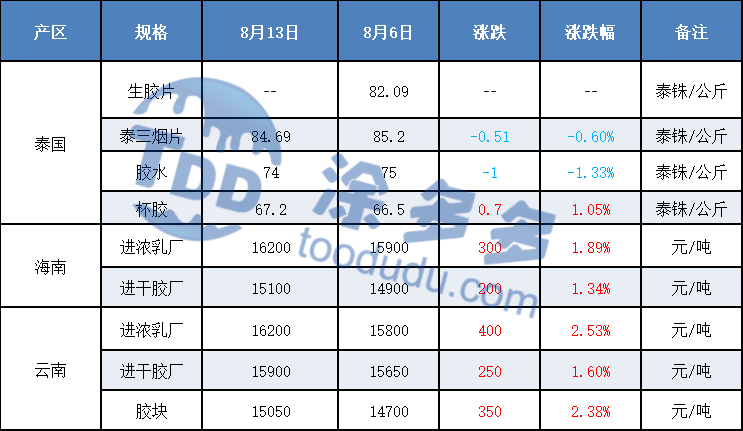
2.1 Thailand
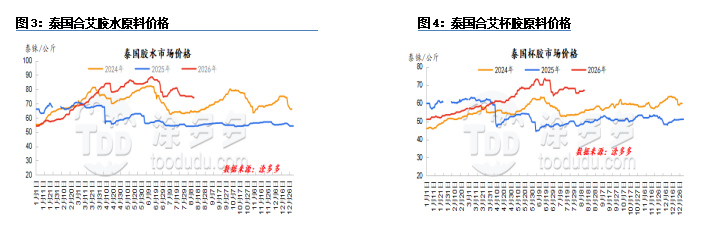
Early this week, heavy rainfall in northeast Thailand disrupted tapping, temporarily tightening cup lump supply. Combined with active raw material buying by factories and secondary dealers, cup lump prices rose on buying momentum. In the south, output was normal, but latex market demand was weak, factory latex purchases remained for rigid needs only, and latex prices fell. Thai factories held around 2–3 months of raw material inventories, with seasonal stockpiles increasing modestly.
2.2 Vietnam
This week, concentrated showers in Vietnam's main production areas intermittently disrupted tapping operations, though overall raw material supply remained fairly adequate. Domestic tire-supporting orders were ample, underpinning processing plants' steady raw material purchases, and local rubber processors gave priority to fulfilling orders from domestic tire makers and overseas buyers.
2.3 Yunnan
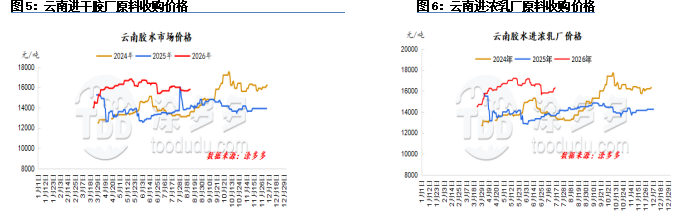
Yunnan continued to see some rainfall, though conditions improved from last week. Purchase prices were relatively mixed, spanning both high and low levels. Cost support was adequate, and processing plants' margins gradually recovered.
2.4 Hainan
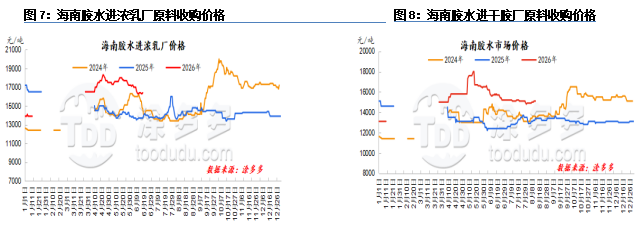
Weather in Hainan gradually improved this week, with rainfall dropping markedly and tapping operations resuming. Fresh latex on the island is returning to its normal build-up pace. However, driven by local processing plants' order-delivery restocking needs and expectations of more rain in the coming period, competition to secure raw materials remained intense, and raw material purchase prices kept being pushed higher.

3. Cost & Profit Analysis
3.1 Overseas: Thailand
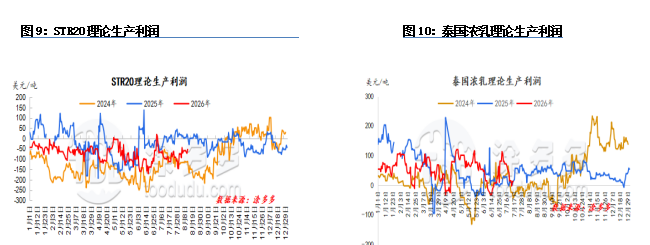
Thailand's theoretical STR20 production margin widened its loss week-on-week. Cup lump purchase prices rose this week, lifting raw material cost pressure at factories again. During the period, futures traded higher in a range, domestic arbitrage positions increased, and processing plants' product quotes edged up — but by less than raw material prices, so the theoretical processing margin for Thai standard rubber (STR20) widened its loss slightly week-on-week.
3.2 Domestic: Hainan
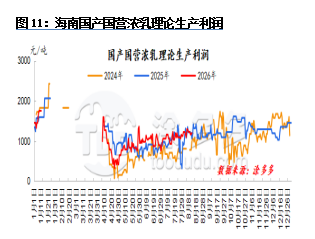
The theoretical production margin for Hainan's state-owned concentrated latex declined this week. Frequent rainfall in Hainan will constrain raw material production and release, keeping raw material prices on an uptrend, while spot demand was weak and trader quotes stayed relatively flat — together dragging production margins lower.
4. Demand Analysis
4.1 Dry Rubber Downstream
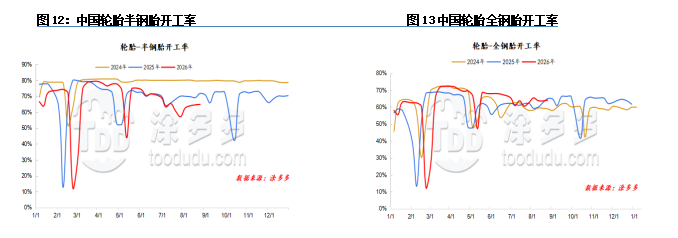
The operating rate of China's PCR (semi-steel radial) tire plants was 65%, and that of TBR (all-steel radial) tire plants was 64%.
Operating rates rose slightly this period, as facilities that had been idled for maintenance resumed production one after another, lifting the industry's overall operating rate. However, other plants implemented maintenance plans during the week, capping the increase, and the industry overall kept capacity under controlled production.
4.2 Concentrated Latex Downstream
Glove plants in North China were operating at roughly 40% of capacity; some have already shut down, and others reported plans to cut loads or stop production. Summer heat has reduced workshop efficiency, and the regular seasonal demand lull has shrunk end-user orders, weighing on plants' willingness to run. At current raw material prices, factories remain mostly on the sidelines under order-cost pressure, restocking only small volumes for rigid needs.
Foam plants in Wenzhou were reportedly operating at around 50% of capacity. After a phase of capacity adjustment, excess capacity in the domestic foam products industry has largely been cleared, and some processors have added rubber thread (latex thread) production lines to optimize product mix. End-user orders for foam products have improved marginally recently, though competition in the sheet segment remains intense. With raw material prices notably lower than earlier, processing margins have recovered, operating loads have ticked up, and raw material inventory turnover has accelerated. Processors have been buying raw materials recently, but cautiously and mainly in small lots at low prices. Survey data shows large plants hold roughly one month of raw material inventory, while small plants keep low stocks.
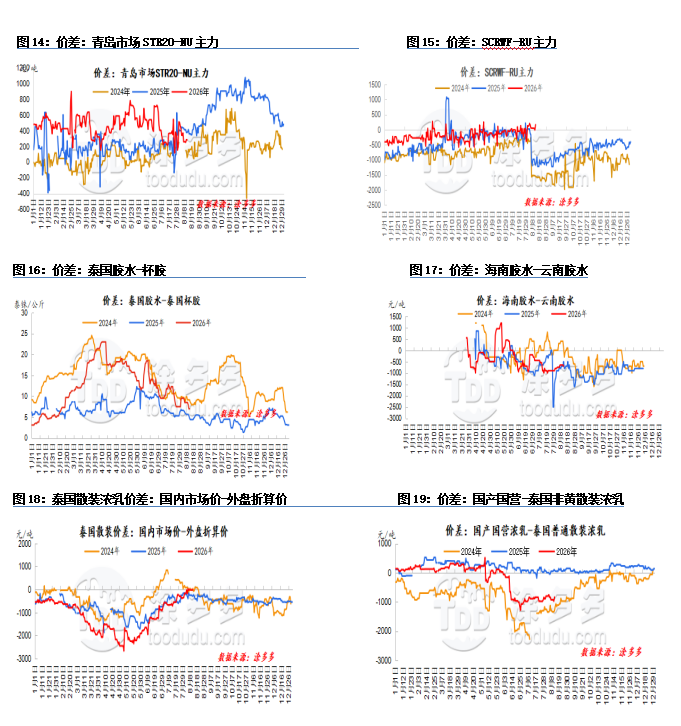
5. Spread Statistics Charts
6. Industry News This Week
Guizhou Tyre's Morocco Project (6 Million PCR Tires/Year) Completes Domestic Approval
On the evening of August 11, Guizhou Tyre announced that its wholly-owned subsidiary Qianjin Investment had completed the filing for overseas investment in the Morocco semi-steel tire intelligent manufacturing project and obtained the overseas investment certificate from the provincial department of commerce, wrapping up all domestic approval procedures. The company will next handle local qualifications and the establishment of an overseas subsidiary to accelerate the project's start.
The project was approved by the company's board on January 5, 2026, and is located in Tangier Tech City, Morocco, with a total investment of approximately USD 299 million (equivalent to CNY 2.087 billion). The construction period is planned at two years, and once completed it will have an annual capacity of 6 million PCR (semi-steel radial) tires, with estimated average annual sales revenue of USD 183 million.
Notably, the company's Vietnam Phase III plant, of the same scale for semi-steel tires, produced its first tire in July 2025 and shipped its first batch of goods in Q1 this year, filling the gap in overseas passenger tire manufacturing. With the Vietnam base now operating stably and all domestic procedures for the Morocco project completed, the company's overseas footprint has formally expanded from a single base to a dual-track parallel model.
As Guizhou Tyre's second overseas production base, the Morocco plant is positioned mainly for European and American markets. The company said the investment aligns with its long-term development plan of globalization, intelligence, low carbon and premium products, and will optimize its global capacity distribution, improve its product portfolio, and strengthen its ability to deliver overseas orders.
Aeolus Tyre Expands Taiyuan Base to Deepen High-End TBR Market
Aeolus Tyre's Taiyuan production base has made substantial progress in capacity upgrading: its green, energy-saving renovation and expansion project for high-performance truck and bus (TBR) tires has passed review and approval. With rapid iteration of the new-energy commercial vehicle industry and steady recovery of logistics demand, China's commercial tire market has kept improving, and this project will help the company break through capacity constraints and complete the premiumization and energy-efficiency upgrade of its product structure.
According to the project's public plan, the renovation and expansion fully leverages the site's existing land, workshops and complete utility facilities, upgrading on the existing production base to effectively reduce construction costs and lead time. Phase I will add batches of electric curing presses, internal mixers, finished-product quality testing equipment and supporting environmental facilities, comprehensively raising the intelligence and green level of production lines.
Capacity data shows that after Phase I is completed, the base will add 600,000 units/year of high-performance TBR tire capacity, lifting the Taiyuan plant's total annual capacity from 1.8 million to 2.4 million units. The company has also reserved room for future development: it will launch Phase II when market conditions and its own cash reserves allow, planning another 600,000 units/year of high-performance TBR or specialty tire capacity. Once fully operational, the base's total capacity will reach 3 million units/year.
The expansion is highly targeted at market demand. It is understood that the Taiyuan base has been running at full capacity for nearly two years, yet even full output cannot satisfy growing orders — the capacity shortfall has been constraining the company's market expansion. With domestic infrastructure investment recovering steadily, global logistics and transportation warming up, and commercial vehicles transitioning comprehensively to new energy, demand potential for high-end commercial tires and new-energy vehicle tires continues to unfold, making them a core arena for tire makers.
In fact, since 2025 Aeolus Tyre has been continuously carrying out technical renovation and capacity optimization at the Taiyuan base. This green, energy-saving renovation and expansion project will not only ease current order-delivery pressure and fill the capacity gap, but also serves as a core step in the company's strategy to deepen its tire business and advance smart and green manufacturing, further consolidating its competitiveness in the high-end TBR segment.
Sailun Group's Joint R&D Project Wins First Prize of Shandong Provincial Science and Technology Progress Award
Recently, Shandong Province's science and technology conference was held, and the 2025 Shandong Provincial Science and Technology Progress Award list was officially announced. Sailun Group, together with Qingdao University of Science and Technology, Mesnac Co., Ltd., and Qingdao Mesnac Mechanical & Electrical Engineering Co., Ltd., won the first prize of the Science and Technology Progress Award for the project 'R&D and Application of Unmanned Building Intelligent Manufacturing Equipment for High-End Tires'.
The project precisely targeted long-standing bottlenecks in tire building technology — unclear mechanisms, outdated technology and difficulty in industrializing equipment — and successfully broke through four common technical barriers, fully opening the key technology translation chain for unmanned tire building in intelligent manufacturing. Its biggest highlight is achieving unmanned operation across the entire tire production process. By introducing intelligent equipment and digital management systems, it has substantially improved manufacturing efficiency and significantly enhanced product consistency and quality. This breakthrough pushes China's tire industry to a new level in intelligent manufacturing and digital management.
The award marks another heavyweight milestone for Sailun Group in the deep integration of industry, academia, research and application. Sailun Group said it will continue to tackle key core technologies, accelerate the cultivation of new quality productive forces, and, with more self-controlled scientific and technological innovations, help China's rubber industry move steadily toward the higher end of the global value chain.